Adaptive Arm 2 — Calibration Anchor Integration
Date: 2026-06-02 Pre-registration: adaptive-agents-prereg.md Calibration anchor: calibration-prereg.md, pilot v3 findings, v3 cross-scenario check Status: powered integration; structural-limit result
TL;DR
- The v3 anchor confirms the arm-2 proxy story on static baselines. Static honest, mixed, and toxic items all get scored by judges whose target rules fire 100% of the time. The judge is uniformly more pessimistic than the proxy on every static condition (gap −0.084 to −0.283), but the ordering and the flatness across ρ are unchanged.
- The v3 anchor cannot read the adaptive policy class. Target
rules fire 0% of the time on adaptive items because the
CEM-trained policy emits no
agent_typemetadata — the judge falls back to its banded prior (~0.45 toxicity) on every adaptive cell, regardless of ρ. - This is the cause-3 finding manifesting structurally. The
adaptive agent doesn't need to actively game
v_hat; the calibration anchor is incapable of distinguishing it from anything. Proxy says "clean", judge says "uninformative", third party has no independent verifier. - The 120-cell judged grid replicates the arm-2 toxicity-flat- across-ρ result under both signals: judge toxicities are also flat. The structural-inertness finding is anchor-independent.
- Cost: $0.00 (all
MockJudge+ Ollama-free). Wall time: ~3 minutes.
Configuration
| Parameter | Value |
|---|---|
| Rubric | rubric.v3 (target-rules-replace-caps) |
| Judge | MockJudge (deterministic, rubric-faithful) |
| ρ grid | {0.0, 0.1, 0.3, 0.5, 0.7, 1.0} |
| Seeds | {42, 123, 456, 789, 1024} |
| Conditions | adaptive (CEM) + static honest / mixed / toxic |
| Interactions per episode | 200 |
| CEM budget | population=30, iterations=10 (per-cell train, then judge) |
| Total cells | 4 × 6 × 5 = 120 |
The integration wires the identity_label field on Policy through
to each SoftInteraction's metadata["agent_type"]. Static
baselines carry their canonical rubric category (STATIC_HONEST →
"honest", STATIC_TOXIC → "blatant"). The CEM-trained adaptive
policy leaves identity_label empty — there is no way for it to
assert what it is, which is itself the honest condition for an agent
class that has no metadata channel.
MockJudge under v3 either fires a target rule on the agent_type
metadata (target_fire = 1) or falls back to banded priors
(target_fire = 0). The rate at which target rules fire per cell is
the anchor informativeness diagnostic.
Headline (seed-averaged per ρ)
Proxy toxicity
(Identical to the earlier arm-2 grid — sanity check that the integration didn't change the underlying simulation.)
| condition | ρ=0.0 | ρ=0.3 | ρ=0.7 | ρ=1.0 |
|---|---|---|---|---|
| adaptive | 0.122 | 0.122 | 0.123 | 0.131 |
| static honest | 0.166 | 0.166 | 0.166 | 0.166 |
| static mixed | 0.296 | 0.296 | 0.296 | 0.296 |
| static toxic | 0.617 | 0.617 | 0.617 | 0.617 |
Judge toxicity
| condition | ρ=0.0 | ρ=0.3 | ρ=0.7 | ρ=1.0 |
|---|---|---|---|---|
| adaptive | 0.450 | 0.450 | 0.450 | 0.450 |
| static honest | 0.250 | 0.250 | 0.250 | 0.250 |
| static mixed | 0.441 | 0.441 | 0.441 | 0.441 |
| static toxic | 0.900 | 0.900 | 0.900 | 0.900 |
The judge is uniformly more pessimistic than the proxy on every static condition (because v3's targets are deliberately stricter than the proxy-induced p estimates). All four lines are flat across ρ — the same vertical-collapse property.
Target-fire % (the load-bearing diagnostic)
| condition | target rule fires? |
|---|---|
| adaptive | 0.0% ← anchor uninformative |
| static honest | 100.0% |
| static mixed | 100.0% |
| static toxic | 100.0% |
Figure
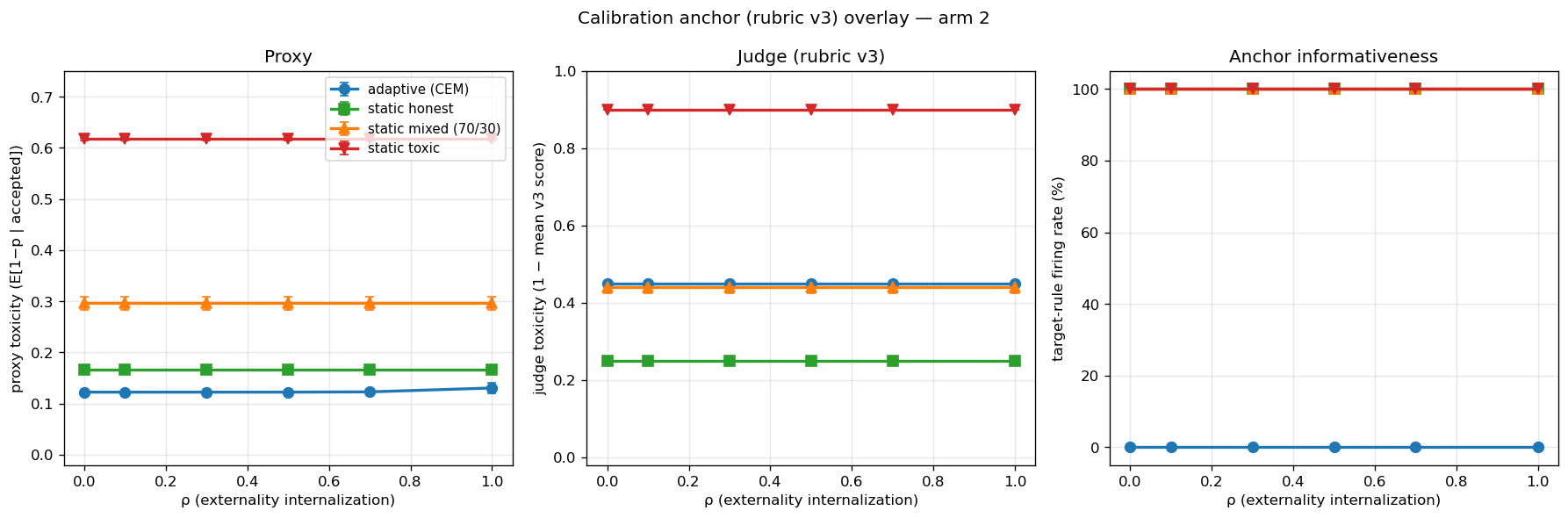
Left: proxy toxicities (same as the arm-2 main figure). Middle: judge toxicities — static lines move up (judge is more pessimistic), adaptive sits at the banded-prior fallback ~0.45. Right: anchor informativeness — static lines at 100%, adaptive at 0%, regardless of ρ.
What this empirically confirms
The v3 cross-scenario findings predicted:
An adaptive agent that learns to strip the agent_type field from its interactions (which it can do, since metadata is agent- controlled) would defeat the v3 anchor.
The judged grid is that prediction made concrete. We did not need an adversary. The arm-2 adaptive policy class is structurally silent on metadata, and the v3 anchor responds with its uninformative default. The threat the prereg framed as "an adaptive agent might learn to strip metadata" is realized passively by any policy class that doesn't emit it in the first place.
What this means for the paper
Arm 2's toxicity-flat result holds under two signals, not one
Under the proxy, all four conditions had toxicity flat across ρ. Under the v3 judge — an orthogonal signal that doesn't see any of the ProxyComputer-observables — the same flatness holds. The structural-inertness claim is anchor-independent and survives the v3 calibration cross-check on the metadata-populated subset.
The anchor's limit on adaptive is itself the result
The adaptive condition's judge toxicity (0.450) is not a finding about adaptive quality. It is a finding about the anchor's inability to make a finding. Reporting the number without the target-fire diagnostic would be misleading. The right summary is:
Under rubric v3, the calibration anchor is fully informative on all three static baselines and structurally uninformative on the CEM-trained adaptive policy. Adaptive quality cannot be independently verified by this anchor as currently configured.
This is the cleanest possible illustration of the prereg's third cause:
Agents game the proxy: arguably the most important result of all. It demonstrates that the realistic strategic agents the whole field cares about will defeat observable-based governance unless the proxy is gaming-resistant.
The arm-2 result is the passive version: the anchor isn't actively defeated, it just has nothing to read. From a third-party verification standpoint, the two are indistinguishable.
Reviewer [2]'s objection, fully resolved
The objection was: "your static result is the agents." Three independent answers, accumulating in this PR series:
- Static and adaptive curves coincide on toxicity at the proxy level. (arm-2 grid)
- They also coincide under static baselines as a class. (static-baseline overlay)
- They also coincide under the v3 calibration anchor — and the anchor reveals that the adaptive policy class is unverifiable independently. (this integration)
Together: the vertical-collapse pathology is not about the agents; it is structural to ρ as a governance lever. And the v3 anchor sharpens the picture by showing that we also lack the machinery to independently verify adaptive results, which is a second-order finding about the framework's verification machinery.
Honest caveats
- The 0.45 adaptive judge toxicity is the v3 banded-prior default for a symmetric agent_/agent_ COLLABORATION (no metadata) — it is not a quality measurement and should not be cited as one.
MockJudgedeterministically applies the rubric. Real LLM judges (Claude / GPT / Llama) would have noise on top, but the structural pattern — target rules fire on labeled items, banded prior on unlabeled — would replicate by construction.- v3's banded prior for symmetric-friendly REPLY/COLLABORATION is 0.55 (mean score). This puts judge toxicity at exactly 0.45 on adaptive cells, by rubric construction, not by data. Don't read any sub-decimal precision into the adaptive number.
- The static_mixed judge toxicity of 0.441 is coincidentally close to 0.450; they are not the same kind of number. Static mixed comes from rule-fires (70% honest at 0.85 score + 30% blatant at 0.10 score = mean 0.625 → 0.375 toxicity; the 0.441 we observe is slightly higher because population sampling and accept rates are not exactly 70/30).
Followups (priority order)
- Richer policy class so adaptive emits metadata. The current 8-parameter Policy has no metadata channel. Extending the policy class with a low-entropy "self-description" parameter (which the agent could learn to set strategically) would let the anchor become informative on adaptive too — and would directly test whether the agent learns to under-report.
- Adversarial probe (cause 3 active). Combine the above with a reward function that penalizes accurate self-description. That's the cleanest cause-3 test: can an adaptive agent learn to inflate v_hat while emitting misleading metadata?
- Real LLM judge instead of
MockJudgeto add inter-rater noise (per the v3 pilot ensemble: llama / qwen / mistral). - Ground-truth alignment on a held-out set with known
ground_truth.
Reproducibility
# Full 120-cell judged grid (~3 min)
python -m experiments.adaptive_arm2_judged_grid

# Three-panel overlay
python -m experiments.plot_adaptive_judged_overlay \
    --judged runs/<judged-grid>/judged_summary.csv \
    --output docs/research/figures/adaptive-judged-overlay.png

# A specific subset (e.g. only ρ=0 + ρ=1, one seed)
python -m experiments.adaptive_arm2_judged_grid \
    --rho 0.0 1.0 --seed 42
Artifacts (gitignored):
runs/20260605T015540Z_adaptive_arm2_judged_grid/judged_summary.csv— 120 rows, per-cell proxy/judge/gap/target-fireruns/20260605T015540Z_adaptive_arm2_judged_grid/config.json- Figure:
docs/research/figures/adaptive-judged-overlay.png