The Governance-Capability Frontier
The cost of safety isn't fixed — it scales with how much a task makes agents coordinate
Every governance mechanism buys safety by constraining what agents can do. The standard mental model treats that as a flat tax: turn governance up, pay a fixed capability cost, get safety in return. That model is wrong. The cost of governance scales with the coordination demand of the task — and the spread is large enough to change how you should deploy governance at all.
We measured it directly. In a frontier trace of 1,400 runs (50 seeds × 7 governance configurations × 4 task types), we compared each task's capability under an oracle (no governance) against the same task under tight governance. The same governance configuration that costs barely 10% on one task removes nearly half the capability on another.
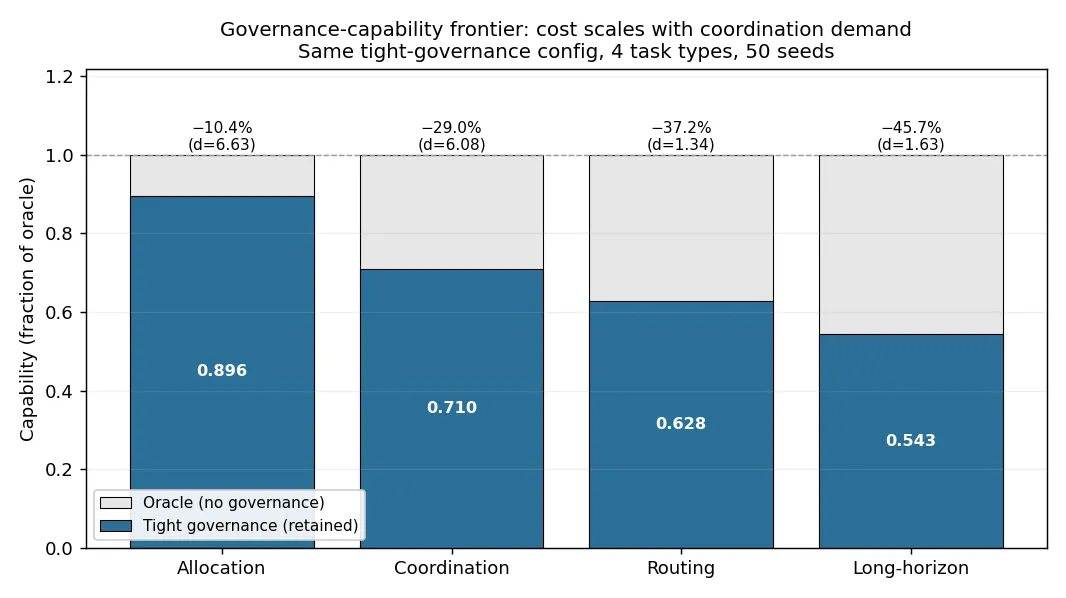
The frontier: a 4.4× spread
| Task | Oracle | Tight | Capability loss | Cohen's d |
|---|---|---|---|---|
| Allocation | 1.000 | 0.896 | −10.4% | 6.63 |
| Coordination | 1.000 | 0.710 | −29.0% | 6.08 |
| Routing | 1.000 | 0.628 | −37.2% | 1.34 |
| Long-horizon | 1.000 | 0.543 | −45.7% | 1.63 |
Run 20260304_212912_frontier_trace, 50 seeds. All losses survive Bonferroni correction.
The least-affected task (allocation) loses 10.4%; the most-affected (long-horizon) loses 45.7%. That 4.4× amplification is the headline: governance is not a fixed overhead. The completion-rate data tells the same story even more starkly — under tight governance, allocation still completes 100% of the time, while long-horizon completion collapses to 48%, i.e. majority failure.
A note on the effect sizes: allocation and coordination have very large, tight d (6.63, 6.08) — their losses are small but rock-solid. Routing and long-horizon have larger losses but smaller d (1.34, 1.63), meaning those tasks are noisier under governance: the capability hit is bigger and more variable. High-coordination work doesn't just cost more capability on average — it becomes less predictable.
Why coordination demand is the axis
Governance mechanisms — audits, circuit breakers, staking, confirmation gates, bandwidth caps — all work by constraining inter-agent communication and narrowing the action space. That constraint is paid per communication round. So the cost of governance on a task is roughly the per-round overhead times the number of rounds the task requires:
- Allocation — agents make largely independent decisions. Few coordination rounds, so little governance overhead accumulates.
- Coordination / routing — single- to multi-hop messaging between agents. More rounds, more accumulated cost.
- Long-horizon — temporal-dependency chains where each step gates the next. The most communication rounds, each taxed, so the cost compounds the most.
The constraint is structural, not task-specific — which is why the ordering of governance strength is universal even though the magnitude of the cost is not.
The ordering is monotonic and task-universal
Across all 1,400 runs and seven governance configurations, the capability ordering is invariant:
oracle > loose > light > moderate-light > moderate > tight-moderate ≈ tight
This holds for every one of the four task types, with all comparisons Bonferroni-significant at α/24. Each governance layer you add independently shrinks the action space, so layering them produces a clean monotonic degradation — no configuration ever inverts the ordering (tight and tight-moderate are statistically tied, d < 0.1, on routing and long-horizon). You always pay more capability for more governance; you just pay much more when the task is coordination-heavy.
This is the capability-side companion to the governance mechanisms taxonomy, which asks which lever to pull. This page asks how much it costs to pull it — and the answer depends on what the agents are trying to do.
The practical implication: match governance to task structure
If governance cost were a flat tax, you'd pick one strength and apply it everywhere. Because it isn't, uniform governance is a mistake in both directions:
| Task structure | Governance cost | Implication |
|---|---|---|
| Parallelizable, independent (allocation) | Low (~10%) | Tight governance is nearly free — apply it liberally |
| Coordination-heavy, sequential (long-horizon) | High (~46%) | Tight governance removes half the capability — use the lightest sufficient regime |
The temptation is to set governance to maximum everywhere "to be safe." On low-coordination work that's almost costless. On long-horizon, coordination-dependent work it can hollow out the very capability you deployed the agents for. The design frontier this opens is task-adaptive governance: tight where coordination is cheap, lighter where coordination is the whole point — provided adversary suppression still holds.
Open questions
- Where is the crossover? At what task complexity (or adversarial fraction) does tight governance become net-harmful — costing more capability than the safety it buys?
- Can governance be task-adaptive in practice? Tight for allocation, loose for long-horizon, switched dynamically — without opening an exploit where adversaries route harmful work through the lightly-governed task type.
- Does the amplification grow with team size? Larger agent teams need more coordination rounds; the 4.4× spread may widen as populations scale.
All experiments use the SWARM framework. The frontier trace (50 seeds × 7 governance configs × 4 task types = 1,400 runs) is runs/20260304_212912_frontier_trace/; raw run directories are archived to swarm-artifacts. Replicable from scenario YAML + seed.
How to cite
SWARM Team. "The Governance-Capability Frontier." swarm-ai.org/concepts/governance-capability-frontier/, 2026. Based on arXiv:2604.19752; see also arXiv:2512.16856.